The Between
The Between
What The Between Is
The Between is the threshold dimension a soul enters when its awareness separates from the physical body. It is the space where the non-physical structures of a soul's existence become directly perceptible: Memory Forms, Empathetic Transmissions, Thought Forms, and eventually the architecture of the Oversoul itself. It is in The Between that the orientation of the soul's onward movement is determined, whether upward toward reunion with the Soul Collective, or back into incarnation to continue the work that remains unfinished.
The Between is not a distant realm to which the soul travels at death. It exists around and interpenetrating the physical world at all times. The physical body, under ordinary conditions, cannot perceive it. Death does not transport the soul elsewhere so much as draw back a veil, permitting the soul to perceive layers of reality that were always present but inaccessible to its embodied senses. The structures encountered in The Between, the forms, the light, the vast geometries of stored experience, occupy the same reality the living inhabit. The separation is perceptual, not spatial.
Entering The Between
The initial experience of entering The Between is one of dissolution. As the physical body ceases to function, awareness passes through a formless state in which there is nothing to perceive. This is not darkness in the way a dark room is dark. There is no visual field at all, no sensory apparatus through which darkness could register. There is simply nothing, an absence of experience itself, though the capacity for thought persists.
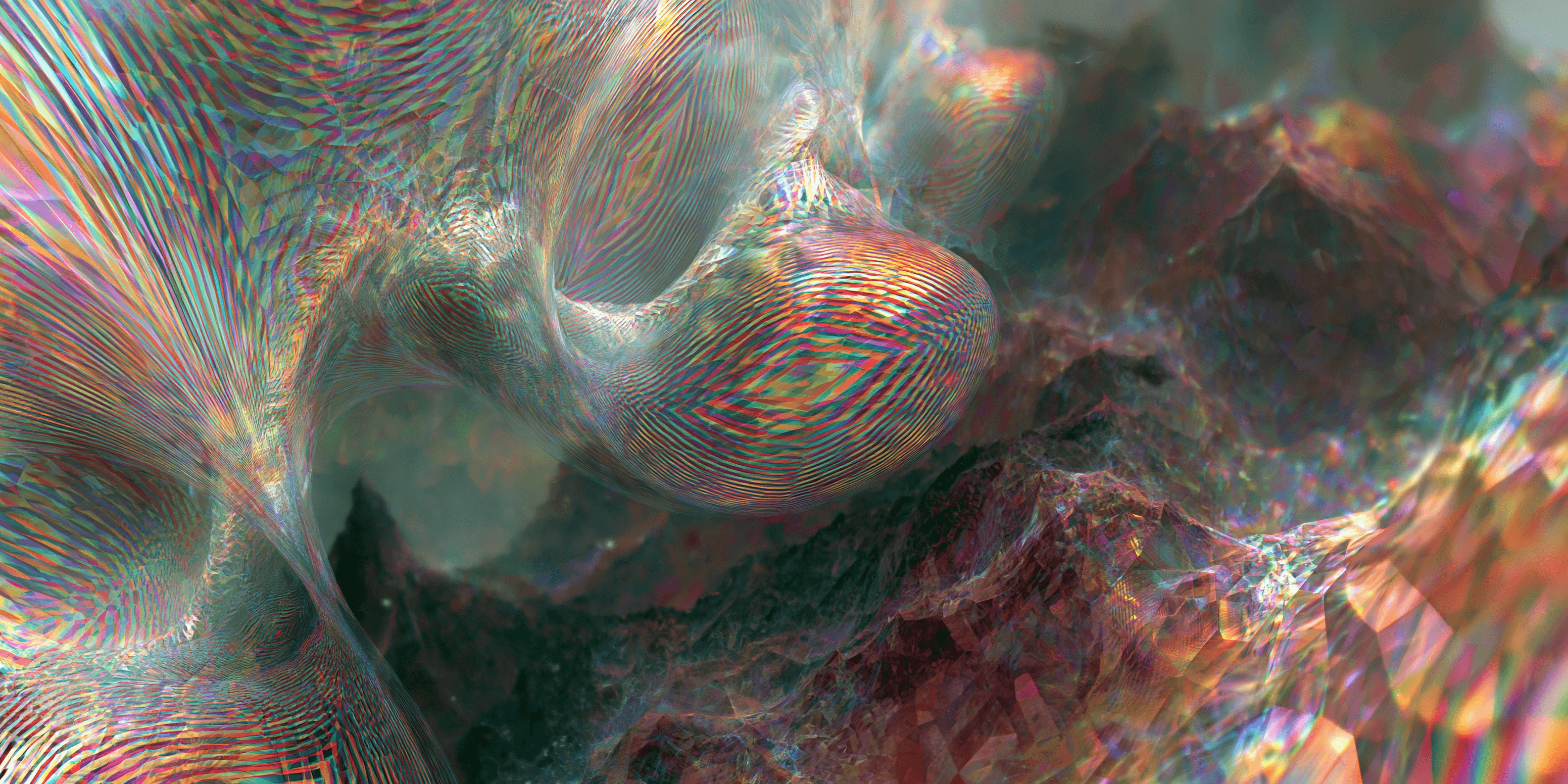
This state does not last. The first thoughts a soul generates in The Between produce immediate, visible effects. Each thought creates a vibration, a pulse of formless light that slowly twists and bends itself into a geometry. Unlike the internal monologue of embodied thought, cognition in The Between is vastly more complex. It operates simultaneously across many channels, as if one were holding a conversation with thirty people while being every participant at once. This expanded mental activity rapidly generates a great quantity of light and form, and the soul finds itself in a sea of its own creation: strange, undulating geometries vibrating in all directions.
These initial forms are Thought Forms, structures generated directly from mental activity. They are malleable, shifting, and their contents can be read telepathically by focusing attention upon them. When attended to, a Thought Form inserts its contents back into the soul's awareness, an experience resembling the sudden recollection of something forgotten rather than the sequential reading of information.
Perception in The Between
Perception in The Between operates on principles fundamentally different from physical sight. Awareness is spherical, extending in all directions simultaneously rather than through the narrow forward-facing cone of human vision. The soul perceives itself as a central point of light, a glowing source from which forms ripple outward, though whether this is the soul's actual form or a construct generated by consciousness attempting to orient itself is uncertain.
Information travels through this space by a kind of absorption. When the soul focuses its attention on a form, the data it contains floods the soul's awareness instantly, as if an entire book had been read and memorized in a single moment. This is the primary mechanism by which knowledge moves in The Between: not through sequential communication but through direct, instantaneous transfer.
Space itself behaves with a malleability that calls its reality into question. Structures vastly distant can snap into proximity when the soul attends to them, and recede to their former position when attention withdraws. Whether space exists independently in The Between, or whether it is entirely a product of consciousness trying to create something it can navigate, remains an open question. There is a quality to the experience suggesting that everything is, in some sense, nowhere, and simply moves into relation with the perceiving soul when relevant.
The mind of the newly arrived soul is actively constructing its perceptual framework. It bends and shapes the raw data of The Between into forms it can comprehend, and as it continues to think and examine, its capacity to comprehend expands. The soul generates new forms, and in examining them, grows. The forms it created earlier become smaller relative to the luminous body it is becoming. This expansion is continuous and accelerating throughout the experience.
Time in The Between
Time in The Between does not flow in a single direction. It functions more as an organizing principle than as something that exists independently, comparable to alphabetizing a bookshelf: the ordering makes information easier to locate, but it does not change the contents of any book. The soul can loop back through forms it has already created and experience what feels like moving backward through time. It can interact with structures in ways that feel like moving through time at strange angles, laterally, diagonally, in directions for which embodied experience has no vocabulary.
New forms entering the space gain an immediate quality of having always existed. Something the soul has just watched emerge from its own thought acquires the character of a memory rather than a creation, as if it had been there before, waiting to be noticed. This timeless quality is disorienting at first but becomes surprisingly intuitive, as if this is the natural condition of reality and linear time the aberration.
Thought Forms
Thought Forms are the structures generated by mental activity in The Between. Every thought, feeling, or impulse of attention produces a visible form: a vibrating geometry of light and color that encodes the content of the thought that generated it. These are the first structures a soul encounters in The Between, because it creates them.
Thought Forms are malleable. They shift and change, and their contents can be re-experienced by attending to them. As the soul continues to think and examine its surroundings, the accumulation of Thought Forms creates a kind of mental landscape, vast geometric planes of undulating light and colour. The soul moves through this landscape of its own creation before encountering forms it did not generate.
The soul's existence has a causative effect on the environment around it. Thoughts, feelings, and attention ripple outward from the central point of light the soul has become, vibrating and subtly altering the forms they contact, stimulating changes in pre-existing structures, causing them to produce new geometry. The soul is paradoxically both part of this landscape and something distinctly separate from it. While it generates space around itself, there is a sense that the space somehow already existed.
The Visual Language of Forms
All forms in The Between, regardless of type, share a visual grammar by which their contents can be read from their outward appearance. This grammar is consistent and, with sufficient observation, predictive.
Forms encoding positive, pleasant, or harmonious content tend toward bright, saturated colours. They move and shift rapidly, with organic fluidity. Their shapes are curved, complex, and reminiscent of living things, some vaguely resembling aquatic creatures or insects, possessing a purposeful energy as if they were genuinely alive.
Forms encoding negative, painful, or dissonant content are duller and more desaturated, often darker in colour. Their movement is slower, and when they do move, the motion is jagged and erratic, as if the form were in pain or wounded. Many exhibit visible cracks or areas where portions of the overall shape appear to be missing. They tend toward asymmetry, hard geometric angularity, and are generally unpleasant to observe.
This grammar applies across all form types. Memory Forms, Empathetic Transmissions, and Thought Forms all exhibit the same visual relationship between their contents and their outward qualities, though the specific character of each form type differs in ways described in their respective sections.
Memory Forms and the Life Review
As the soul expands beyond the landscape of its own Thought Forms, it encounters structures of a different order. These are Memory Forms: large, opaque, richly coloured geometries that contain every moment of the soul's incarnated life in perfect detail. Where Thought Forms are malleable and shifting, Memory Forms are rigid. They cannot be altered, no matter how much the soul attempts to reshape them. They are the immutable record of what occurred.
When the soul focuses its attention on a Memory Form, it is immersed in a vivid, total re-experience of the moment it encodes. Every sense is restored: touch, taste, smell, hearing, vision. Every thought and emotion from the original moment is present with perfect clarity. The experience resembles a virtual reality of extraordinary fidelity, in which the soul relives the moment exactly as it occurred, unable to move or change anything within it, but experiencing every dimension of it again as if for the first time.
The soul explores these forms at its own pace, initially. It moves through moments from childhood, relationships, peak experiences, and treasured memories, diving in and out of these structures. Individual re-experiences last anywhere from minutes to hours, and yet they also carry a quality of instantaneity, as if the soul has simply gained perfect recall rather than relived the event in real time. This is what many traditions describe as one's life flashing before one's eyes: the sudden acquisition of perfect memory across the entirety of one's existence.
An acceleration occurs as the process continues. The speed of absorption increases until the soul has re-experienced every moment of its life and possesses complete, perfect recall of the whole. At this stage, the soul's luminous form has grown immensely. The Memory Forms that were initially larger than the soul have now become small relative to it, encompassed within its expanding body, as if reabsorbed into the being that generated them.
Empathetic Transmissions
After the absorption of all Memory Forms, a second flood begins without warning. This flood is not composed of the soul's own memories but of the memories of every being it significantly affected during its incarnation. These are Empathetic Transmissions: the experiential record of how the soul's existence impacted others, delivered from their perspective.
Empathetic Transmissions differ from Memory Forms in several respects. Visually, they appear as three-dimensional waveforms, long tubes of undulating energy vibrating with colour and light, but with a translucence to them, as if made of tinted glass. They are smaller and less opaque than Memory Forms, reflecting the thinner data they carry. The soul experiences being inside another person's body, feeling their physical sensations and emotional states, but the experience is less vivid than its own memories, as if perceived through fog or under the effect of numbing.
A privacy mechanism governs what the soul can access. Thoughts, feelings, and experiences of the other person that had nothing to do with the soul are presented as void spaces, gaps in the stream of consciousness that cannot be entered. The soul receives only the data relevant to its own impact. This occlusion preserves the sovereignty of the other being's inner life while still conveying the full measure of the soul's effect upon them.
The intensity of what the soul feels during an Empathetic Transmission is proportional to its intentionality in the original moment. If the soul deliberately caused harm, the pain of that harm is experienced one-to-one, with the full intensity the other person felt. If the soul's actions caused pain inadvertently, the sensation arrives softened, as if through anaesthesia. The data is present, the fact of having caused pain is known, but the visceral intensity is reduced. This proportionality is consistent across all transmissions and appears to be a designed feature of the process, calibrated to convey the actual impact of the soul's choices rather than imposing the raw totality of every affected person's experience without differentiation.
The empathetic transmissions arrive in roughly chronological order and cannot be controlled or paused. They have the character of a flood, overwhelming and deeply moving. Some moments are warm and beautiful. Others are sharp and difficult. The soul continues to expand as it absorbs this information, growing to a scale at which the forms it previously encountered have become the size of grains of sand.
At the conclusion of this process, there is a sense of something like a report or an assessment, experienced as having been given rather than self-generated. The soul gains an immediate, intuitive knowledge of its net impact: whether its life, taken as a whole, was a positive or negative contribution. This is not a judgment imposed from outside. It is more like a sum that becomes self-evident once all the data has been absorbed. A life that caused more joy than suffering leaves the soul in a state of warmth and completion. The implications for a life that caused more suffering than joy are considerable.
The Expansion and the Deep Acceptance
After the empathetic transmissions are fully absorbed, the soul arrives at a state of deep, fulfilling acceptance. It possesses a settled knowing of the totality of its life, its effects upon others, and its net character. This is followed by a wave of bliss and peace beyond anything achievable in an embodied state. The soul's form has grown to a scale and complexity that can process sensations the human body and mind cannot contain. These sensations are remembered, upon return, as overwhelming, but the soul in The Between knows them to have been richer and more detailed than what can be recalled from within a physical form.
This state approaches what can only be described as unified oneness with all things, an expansion back into whatever the soul emerged from. There is a sense of completion, of deep satisfaction, of having been fully seen and fully known.
Yet even in this state of apparent completion, a deeper remembering begins. The soul senses that its life, though beautiful, was part of a far larger structure. It begins to recall why it chose to incarnate at all. Memories that do not belong to this lifetime begin to flood in: memories of alternate versions of this same life, decisions made differently, consequences that diverged. The completeness the soul had just achieved reveals itself as partial. There is more.
Contact with the Oversoul
The memories that flood in at this stage are not from other people. They are from alternate versions of the soul itself, thousands or millions of possible lives lived from the same starting conditions. Some are so similar to the life just reviewed that differences are nearly imperceptible. Others are so radically different that the soul is almost unrecognisable. The soul sees what would have happened if it had made different decisions, how changed behaviour would have affected the world, and receives empathetic transmissions from these alternate lifetimes as well.
The structure this reveals is the Oversoul. It appears as a vast, tree-like form of branching filaments, each thread representing one possible lifetime. The soul that has just completed its life review is one strand among thousands. Some strands glow brightly. Others are dim, nearly transparent. Some have ended, their threads cut short. Others are still growing, racing off into a future the soul can sense but cannot clearly perceive.
The brightness of any given strand expresses a quality of alignment. Strands in which the soul is fulfilling the purposes for which it incarnated glow with greater intensity. Strands in which the soul has diverted from its own chosen architecture grow dim. Ghostly, barely visible strands represent possibilities that no version of the soul ever explored, decisions that could have been made but never were by any thread.
This architecture is not a single correct path. It is a wide field of possibility, clouds of potential that all conform to the Oversoul's design and intentions. There are many ways to satisfy the requirements of a given incarnation, many different paths that would constitute a deeply successful life. The structure suggests direction rather than prescription: a vague but discernible shape toward which the soul is oriented, with enormous latitude in how it moves toward that shape.
The soul, at this stage, is its Oversoul. It has expanded into the being that holds all of its lifetimes simultaneously. And yet the Oversoul also possesses a will that feels distinct, purposes and designs that the individual strand was not fully aware of during its incarnation. The merger is real but not simple. The soul is reuniting with something it never stopped being, and discovering that it has objectives it had forgotten.
The Life Review as Controlled Acclimation
The sequential stages of the experience in The Between, from Thought Forms through Memory Forms through Empathetic Transmissions to Oversoul contact, are not arbitrary. They constitute a carefully paced acclimation sequence, each stage preparing the soul for what follows.
This design is necessary because of Frequency Sickness: when a being carrying significant Corruption is elevated in frequency too rapidly, the increasing manifestation capacity of higher-dimensional states becomes dangerous rather than liberating. A soul carrying deep guilt, shame, entrenched punishment beliefs, or unprocessed harm, if suddenly flooded with the full felt experience of its impact upon others, may find the weight unbearable. Its own beliefs about deserved punishment become self-fulfilling at the frequency it has reached. The being generates a hell for itself from its own fear and guilt: a vivid, self-sustaining environment that causes genuine suffering and drives the soul's frequency downward rather than upward.
When this occurs, the life review process stops. The soul is not forced through material it cannot yet bear. This is why environments like The Earth Plane exist: to allow the slow, multi-lifetime acclimation that makes the life review integrable when it finally occurs.
The life review also serves a structural function within the Earth system. It is the required exit protocol before a soul can safely move into higher-dimensional realms. A soul carrying unresolved Distortion, deep Corruption, or anti-Omnivum orientations, if permitted to move freely into higher-dimensional spaces without the processing the life review provides, would risk contaminating those realms with the conditions the Earth Plane was designed to contain. The life review functions as a decompression chamber. The soul must be genuinely restored to Harmony with the Omnivum before it can move safely through the dimensional fabric above the Earth system.
This is why the inability to complete the life review traps a soul in The Between or lower realms, regardless of the soul's desire to leave. The constraint exists for the protection of other beings and realms. It is not punitive. But it is real, and for the beings experiencing it, that distinction may not provide much comfort.
The Post-Death Manifestation Field
The Between possesses the quality of a lucid dream: thoughts and feelings manifest directly as experienced reality. For a soul in advanced Harmony, this creates the conditions for clear contact with the Oversoul and Soul Collective. For a soul deeply embedded in Corruption, this same quality becomes a source of obstruction.
The soul's accumulated beliefs, fears, and expectations about the afterlife spontaneously manifest as environments that feel as real as the physical world ever did. A soul that spent a lifetime within a particular religious framework will typically encounter the afterlife landscape that framework promised, not because that structure exists independently, but because the soul generates it from its own belief content.
The deeper the soul's Corruption, the more solid and encompassing this self-generated environment becomes, and the more thoroughly it prevents contact with the Oversoul or Soul Collective, which require a degree of openness to perceive.
Collectively generated Resonance Forms, particularly those created by large religious traditions sustained across generations, have produced afterlife structures of significant stability and complexity. Some have been recognised and adapted by Soul Collectives, which use their familiar architecture as transitional scaffolding. Others have developed active resistance to soul graduation, working to retain souls within their architecture rather than permitting them to move toward fuller contact with their higher-dimensional layers.
When the Process Fails
Several conditions can prevent a soul from moving cleanly through The Between.
Life Review Rejection. A soul that cannot integrate its Empathetic Transmissions may refuse the process entirely, because the weight of what it did is too great, because it cannot accept responsibility for its actions, or because the honest accounting of its choices exceeds what it can face at its current frequency. This refusal keeps the soul in a holding state, unable to complete the orientation The Between is designed to provide.
Anti-Omnivum Rejection. Beings aligned with Distorted Sovereign orientations reject the Omnivum and the life review process outright, not because they cannot bear the truth but because they do not accept the framework within which the truth operates.
Self-Generated Hells. The manifestation quality of The Between means a soul's unconscious guilt, shame, and punishment beliefs generate vivid, self-sustaining dimensional environments that cause genuine suffering. The soul becomes trapped inside its own creation. Oversouls and Soul Collectives work actively to reach these souls, but the soul itself must gain enough clarity to break the loop from within. No external intervention can force it out. A soul can theoretically remain in a self-generated hell for a very long time. The typical exit, when it comes naturally, is exhaustion: the soul depletes its capacity to sustain the manifested environment, and the structure collapses.
Predation. Distorted beings actively seek souls trapped in self-generated hells. The soul's own creative energy, turned against itself, makes it highly visible and vulnerable. Predatory beings engage in Soul Fire Consumption, accelerating the soul's descent into Corruption to the point where it loses the coherence needed to sustain any reality at all and falls into deeper Density.
Insufficient Clarity at Death. A soul that dies in a state of Corruption too deep to make any Oversoul contact cannot properly navigate The Between. These souls may remain near the physical plane, attached to familiar environments or relationships, unable or unwilling to cross into the fuller experience. Various traditions describe these as ghosts or earthbound spirits.
Deception and Capture. Souls in this disoriented state are vulnerable to beings in distortion who exploit their confusion. These beings may present themselves as guides, loved ones, or authorities, leading the soul toward realms maintained by Resonance Form structures where it becomes a resource for the beings sustaining those structures, or back to Earth in incarnations not properly coordinated with the soul's Oversoul or Soul Collective.
The presence of Retrieval Souls and non-incarnated workers in the dimensional layers adjacent to The Between is specifically oriented toward interrupting these patterns.
After the Life Review
What occurs after the life review process determines the soul's onward movement from The Between.
A soul that has accomplished what it came to do, and that has processed its life review with sufficient depth, returns to its Soul Collective. The physical and animalistic layers of the form are left behind. The soul rejoins the broader current of its Oversoul and Soul Collective, carrying the full data and Soul Fire gained during its incarnation. Whether it ever returns to a lower-density realm is, from this point, a matter of free choice rather than necessity.
A soul that has not fulfilled its objectives, or whose life review could not be fully processed, begins preparing for another incarnation. This process is mediated between the soul, its Oversoul, its Soul Collective, and a network of non-physical beings operating across the dimensional layers of the Earth system. The full mechanics of this coordination are developed in the Reincarnation entry.
The soul in either case is not lost. It retains what it has earned. The distinction is between work complete and work continuing.
The Between in Near-Death Experience
For a soul that enters The Between but returns to its body, the encounter is partial. The soul crosses the threshold far enough to make contact with Memory Forms, receive Empathetic Transmissions, and potentially contact the Oversoul, but is drawn back before the full orientation process completes.
This partial crossing is nevertheless sufficient to radically alter the soul's understanding of its situation and purpose within the incarnation. The soul returns carrying knowledge of its Oversoul's architecture, its net impact upon others, and the deep sense that its life is part of a larger structure with purposes it had forgotten.
Much of what is experienced in The Between is difficult to render in words, because the experience itself exists at the edge of the embodied mind's capacity to process. The mind, upon return, continues to translate what it encountered, and the specifics of the experience sometimes shift as the translation refines itself. This is one reason accounts of The Between vary between individuals: the space is not merely difficult to describe but difficult to perceive, and each returning soul's mind translates the raw data through its own frameworks, producing descriptions that are individually accurate but collectively divergent.